

- Quick Answer: Trade Name vs Corporation
- What Is a Trade Name?
- What Is a Corporation?
- The Misunderstanding Worth Clearing Up
- Side-by-Side Comparison
- When a Trade Name Alone Is Enough
- When You Need a Trade Name on Top of a Corporation
- When You Need Full Incorporation
- Common Mistakes to Avoid
- Frequently Asked Questions
An Ontario trade name and a corporation solve two different problems, and they’re not actually mutually exclusive: a trade name lets you operate under a brand name that isn’t your legal name, while a corporation creates a separate legal entity with its own liability protection and tax treatment. Many businesses end up using both at once: a numbered corporation operating under a customer-friendly trade name is a common setup in Ontario.
This guide clears up what each one actually does, when a trade name alone is enough, when you need to incorporate instead, and how the two work together.
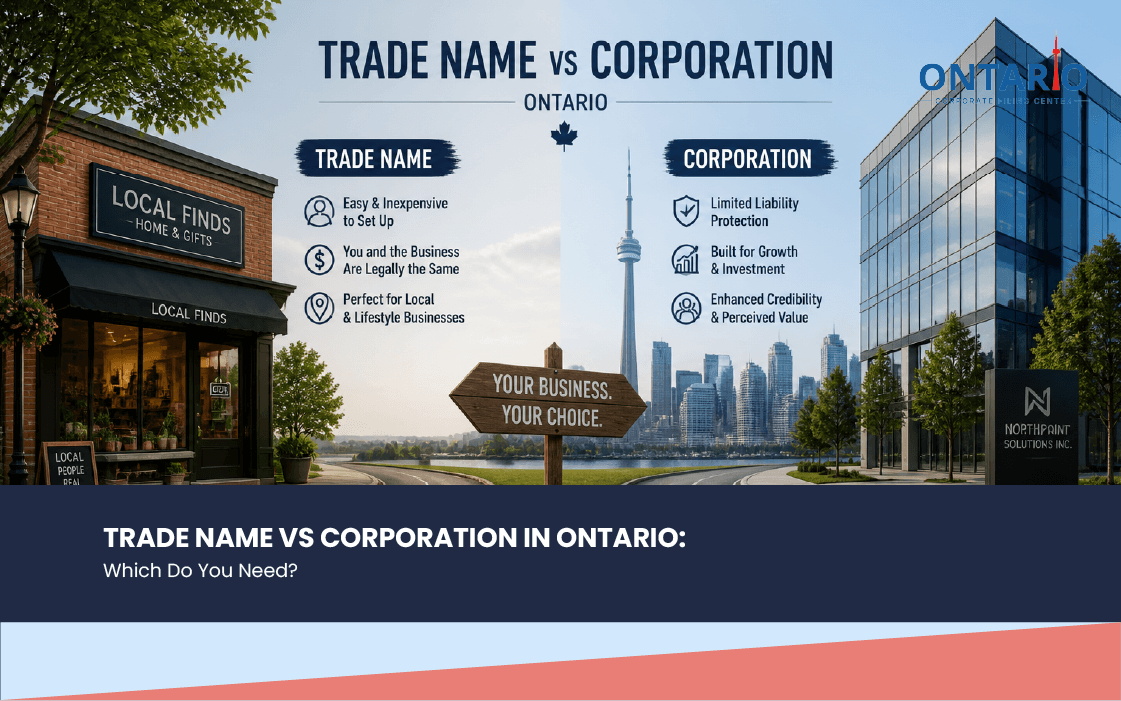
Trade Name vs Corporation
- A trade name (also called an operating name or “doing business as”) registers a name under the Business Names Act so you can operate publicly under something other than your legal name. It costs $60, lasts 5 years, and does not create a separate legal entity or protect the name from being used by others.
- A corporation creates a separate legal entity under the Ontario Business Corporations Act (OBCA), generally limiting your personal liability and changing how the business is taxed. It costs $300 in government fees and takes about 5 business days to process online.
- A corporation can also need a trade name. If your corporation operates under a name other than its full legal corporate name, for example, a numbered company like “12345678 Ontario Inc.” doing business as “Maple Street Coffee,” you need to register that operating name as a trade name too.
What Is a Trade Name?
A trade name (also called an operating name or “doing business as”/DBA) is any name a business uses publicly that’s different from its legal name. Under the Business Names Act, this applies in three situations:
- An individual (sole proprietor) running a business under any name other than their own full legal name
- A partnership whose business name leaves out the full names of all the partners
- A corporation using any name other than its full corporate legal name
A trade name registration:
- Costs $60 and is valid for 5 years
- Does not, by itself, grant exclusive rights to the name; the Business Names Act specifically does not protect the exclusivity of a registered name
- Must be updated within 15 days if there’s a change to your address, primary business activity, or principal place of business
- Does not create a separate legal entity; the person or corporation behind the trade name remains legally responsible in the same way they were before registering it
If real brand protection matters to you, a trade name registration isn’t what provides it. A trademark under the federal Trademarks Act is the separate process that actually protects a name from use by others.
What Is a Corporation?
An Ontario corporation, incorporated under the OBCA, is a separate legal entity from the people who own and run it. It can enter contracts, own property, and be sued in its own name. Incorporating costs $300 in government fees, with online processing typically completed within about 5 business days. Once incorporated, the corporation’s name is protected within Ontario in a way a trade name simply isn’t.
The Misunderstanding Worth Clearing Up
People sometimes assume registering a trade name is a lighter-weight alternative to incorporating, as if it gives you some of the same protections at a lower cost. It doesn’t. A trade name is purely a naming registration. It doesn’t limit your personal liability, doesn’t create a separate legal entity, and doesn’t change how your business income is taxed. If you’re a sole proprietor and you register a trade name, you’re still a sole proprietor with unlimited personal liability; you’ve just given yourself a business-facing name to operate under.
The two structures answer different questions entirely: a trade name answers “what name can I operate under,” while incorporation answers “how is my business legally structured and taxed.”
Side-by-Side Comparison
| Trade Name | Corporation | |
|---|---|---|
| What it is | A registered operating name under the Business Names Act | A separate legal entity under the OBCA |
| Creates a separate legal entity? | No | Yes |
| Personal liability | Unchanged, the underlying individual or entity remains liable as before | Generally limited to the corporation’s assets |
| Government fee | $60 | $300 |
| Validity | 5 years, renewable | Ongoing, subject to annual return filings |
| Name protection | None; doesn’t stop others from using a similar name | The corporate name is protected within Ontario |
| Can be used by | Individuals, partnerships, and corporations | N/A, this is the entity itself |
| Tax return | Same as whoever holds the registration (personal T1 for a sole proprietor) | Corporate (T2), separate from personal return |
When a Trade Name Alone Is Enough
If you’re operating as an individual sole proprietor and want a business-facing name without the cost or complexity of incorporating, registering a trade name is the standard route. You remain a sole proprietor: unlimited personal liability, income reported on your personal tax return, and no separate legal entity. This is a common and reasonable choice for testing a business idea or for a low-risk operation where liability exposure isn’t a major concern.
When You Need a Trade Name on Top of a Corporation
If you’ve already incorporated, especially as a numbered company, and you want customers to see a name other than your legal corporate name, you need to register that name as a trade name too. The corporation still provides the liability protection and tax treatment; the trade name just gives it a public-facing identity. This is a very common combination: incorporate for the legal and tax benefits, then register a trade name for branding.
When You Need Full Incorporation
If liability protection matters, whether because your business involves contracts, employees, physical premises, or anything that could result in a lawsuit or significant debt, a trade name doesn’t address that at all. Only incorporating creates the separate legal entity that limits personal liability for business debts. If you also want to defer tax by keeping profits inside the business rather than withdrawing everything personally, that similarly requires incorporating, since a trade name doesn’t change how income is taxed.
Common Mistakes to Avoid
Assuming a Trade Name Provides Liability Protection
It doesn’t. Only incorporating creates a separate legal entity that limits personal liability.
Assuming a Trade Name Protects Your Brand Name
It doesn’t. The Business Names Act specifically doesn’t guarantee exclusive rights to a registered name; a trademark under the federal Trademarks Act is the actual protection mechanism.
Forgetting a Numbered Company Still Needs a Trade Name for Public Branding
If your corporation operates under anything other than its exact legal name, that operating name needs its own Business Names Act registration.
Missing the 15-Day Update Window
Changes to your address, activity, or principal place of business need to be reported within 15 days under the Business Names Act, whether you’re registered as an individual or a corporation.
Not Tracking Your Own Renewal Date
Trade name registrations expire after 5 years, and the Ministry doesn’t reliably remind you; the responsibility for tracking and renewing falls on the registrant.
Frequently Asked Questions
Does a trade name give me the same protection as a corporation?
No. A trade name is only a name registration under the Business Names Act. It doesn’t create a separate legal entity, doesn’t limit personal liability, and doesn’t change how income is taxed. Only incorporating provides those things.
Can a corporation need a trade name too?
Yes. If a corporation operates under any name other than its exact full legal name, for example a numbered company using a customer-facing brand name, that operating name must be registered as a trade name under the Business Names Act.
How much does a trade name registration cost in Ontario?
$60, and it’s valid for 5 years before renewal is required.
How much does it cost to incorporate in Ontario?
The government filing fee is $300, with online processing typically completed within about 5 business days.
Does registering a trade name protect my business name from being used by someone else?
No. The Business Names Act specifically doesn’t protect the exclusivity of a registered name. A federal trademark under the Trademarks Act is a separate process that provides actual name protection.
If I’m a sole proprietor with a trade name, am I still personally liable for business debts?
Yes. Registering a trade name doesn’t change your legal status; as a sole proprietor, you remain personally liable for the business’s debts and obligations regardless of what name you operate under.
Ready to Move Forward?
Register an Ontario Trade Name with Corporation Ontario (Ontario Corporate Filing Center), or incorporate an Ontario Corporation if you need liability protection and separate tax treatment.
Incorporate an Ontario Corporation