

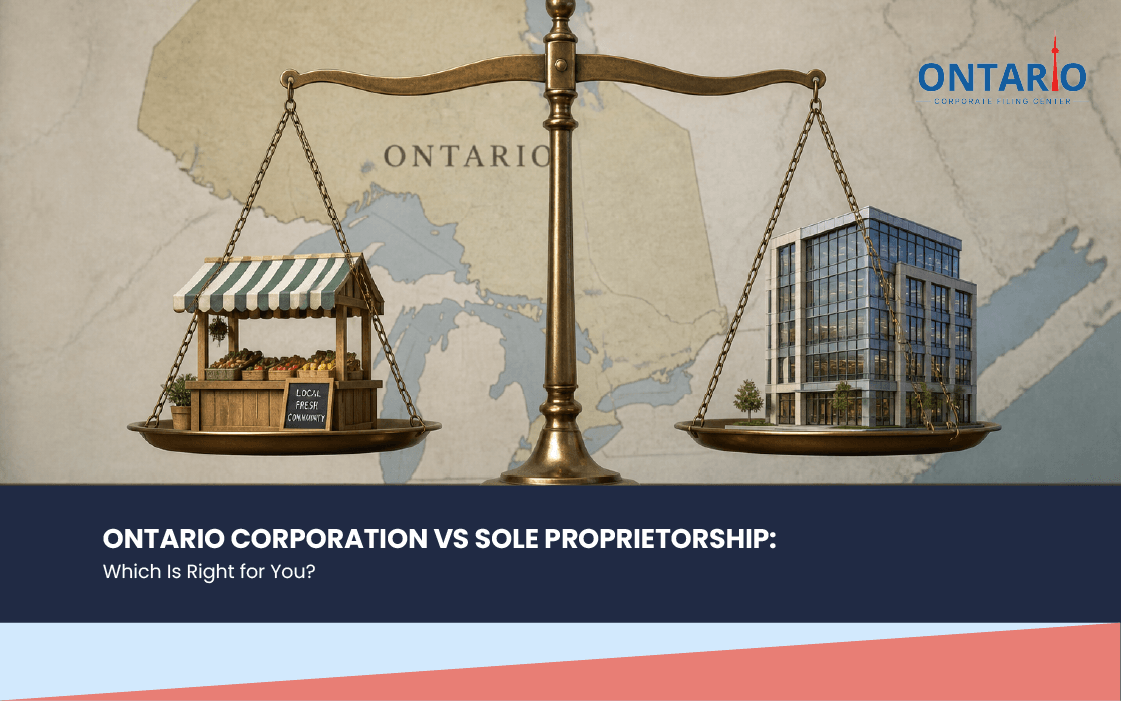
The choice between an Ontario corporation and a sole proprietorship comes down to a trade-off: a sole proprietorship is cheaper and simpler to set up, while a corporation creates a separate legal entity that limits your personal liability and changes how your income is taxed. Neither is automatically the “better” choice; it depends on the risk your business carries and how much administrative complexity you’re willing to take on.
This guide compares both structures directly: what each one actually is, how registration works, what the government fees are, and how liability and taxation differ, using only figures confirmed against Ontario and CRA sources.
Corporation vs Sole Proprietorship
- Sole proprietorship: you and the business are legally the same entity. Business income is reported on your personal tax return (T1). Registering a business name costs $60 and is valid for 5 years. You carry unlimited personal liability for business debts.
- Corporation: the business is a separate legal entity from you. It files its own corporate tax return (T2). Ontario incorporation costs $300 in government fees, processed in about 5 business days online. Your personal liability for the corporation’s debts is generally limited.
- Both structures are subject to the same federal GST/HST small supplier rule: if your taxable revenue is $30,000 or less over four consecutive calendar quarters, you’re not required to register for or charge GST/HST.
What Is a Sole Proprietorship?
A sole proprietorship is the simplest way to run a business in Ontario: you operate as an individual, and the business has no separate legal existence from you. If you conduct business under your own exact legal name, you generally don’t need to register anything with the province. If you use any other name, such as “Jane’s Catering” instead of “Jane Smith,” you’re required under the Business Names Act to register that business name.
Registering a business name gets you a Master Business Licence (MBL) and a Business Identification Number (BIN), issued by ServiceOntario. This registration:
- Costs $60 and is valid for 5 years, after which it must be renewed
- Is typically processed immediately when filed online
- Does not, by itself, grant exclusive rights to the name; the Business Names Act specifically does not protect the exclusivity of a registered name, so a similar name could still be registered by someone else
- Must be updated within 15 days if there’s a change to your address, primary business activity, or principal place of business
If you miss the renewal deadline, Ontario allows a 60-day grace period after expiry to renew before you’d need to file a brand new registration instead.
What Is an Ontario Corporation?
An Ontario corporation, incorporated under the Ontario Business Corporations Act (OBCA), is a separate legal entity from the people who own and run it. It can enter contracts, own property, and be sued in its own name, and its existence continues independently of any single owner or director. Incorporating in Ontario costs $300 in government fees, with online processing typically completed within about 5 business days.
Liability: The Core Difference
This is usually the deciding factor between the two structures.
Unlimited Personal Liability
You and the business are legally one and the same. If the business can’t pay its debts, defaults on a lease, or is sued, your personal assets, savings, home, and other property are potentially on the line. There’s no legal separation to fall back on.
Generally Limited Liability
The corporation is a separate legal entity. Generally, if the business incurs debts or is sued, the corporation’s assets are at risk, not your personal assets, provided normal corporate formalities are respected. This protection isn’t absolute; directors can still be personally liable in specific situations (for example, certain unpaid employee wages or unremitted source deductions), and lenders often require personal guarantees from small business owners regardless of the corporate structure.
Taxation
Sole Proprietorship
Business income and expenses are reported on your personal income tax return (the T1), combined with any other personal income you have, and taxed at your personal marginal tax rate.
Corporation
The corporation files its own corporate income tax return (the T2), separate from your personal return. Income is taxed at corporate rates, and you’re taxed personally only on what the corporation pays out to you as salary or dividends. This separation is what enables tax deferral strategies for corporations, since profits left inside the corporation aren’t taxed at your personal rate until they’re paid out.
GST/HST — Same Rule for Both
Regardless of which structure you choose, you’re considered a small supplier and don’t need to register for or charge GST/HST if your taxable revenue stays at or under $30,000 over four consecutive calendar quarters. Once you exceed that threshold, either through a single quarter or cumulatively, you generally have 29 days to register.
Side-by-Side Comparison
| Sole Proprietorship | Ontario Corporation | |
|---|---|---|
| Legal status | Same legal entity as the owner | Separate legal entity |
| Personal liability | Unlimited | Generally limited to the corporation’s assets |
| Government registration fee | $60 (only if operating under a name other than your own) | $300 |
| Registration validity | 5 years, renewable | Ongoing, subject to annual return filings |
| Tax return filed | Personal (T1) | Corporate (T2), separate from personal return |
| GST/HST small supplier threshold | $30,000 over 4 consecutive quarters | $30,000 over 4 consecutive quarters |
| Name protection | None; the Business Names Act doesn’t protect exclusivity | The corporate name is protected within Ontario |
| Ongoing corporate filings | None | Annual return required |
Which One Is Right for You?
There’s no single revenue number or business type that makes this decision for you, but a few questions point in one direction or the other:
You Carry Meaningful Liability Risk
If your business involves contracts, employees, physical premises, or anything that could result in a lawsuit or significant debt, the liability separation a corporation provides is often worth the added cost and complexity.
You’re Testing an Idea Before Committing
A sole proprietorship’s lower cost and simpler paperwork make it a common starting point for testing a business before deciding whether to incorporate later.
You Plan to Keep Profits in the Business
The tax deferral benefit of a corporation only helps if you’re leaving some income inside the company rather than withdrawing all of it personally.
Your Industry or Partners Expect It
Some clients, lenders, and partners simply prefer or require dealing with an incorporated business.
Many businesses start as a sole proprietorship and incorporate later once revenue, liability exposure, or tax planning needs justify the added structure. Moving from a sole proprietorship to a corporation is a normal transition, not a sign you started wrong.
Common Mistakes to Avoid
Assuming a Sole Proprietorship Name Registration Protects Your Brand
It doesn’t. The Business Names Act specifically doesn’t guarantee exclusive rights to a registered name.
Forgetting the 15-Day Update Window
Changes to your address, activity, or principal place of business need to be reported within 15 days under the Business Names Act.
Missing the Renewal Deadline
Registrations expire after 5 years, though Ontario allows a 60-day grace period afterward before you’d need a brand new registration instead.
Believing Incorporation Eliminates All Personal Liability
It limits liability for business debts under normal circumstances, but directors can still face personal liability in specific situations, and lenders commonly require personal guarantees regardless of structure.
Overlooking That GST/HST Rules Are the Same Either Way
The $30,000 small supplier threshold applies whether you’re a sole proprietor or a corporation; incorporating doesn’t change this obligation.
Frequently Asked Questions
How much does it cost to register a sole proprietorship in Ontario?
Registering a business name (required only if you’re operating under a name other than your own) costs $60 and is valid for 5 years.
How much does it cost to incorporate in Ontario?
The government filing fee is $300, with online processing typically completed within about 5 business days.
Does a sole proprietorship protect my personal assets?
No. As a sole proprietor, you and the business are legally the same entity, so your personal assets can be at risk for business debts and liabilities.
Do I have to charge GST/HST as a sole proprietor?
It depends on revenue, not structure. If your taxable revenue is $30,000 or less over four consecutive calendar quarters, you’re considered a small supplier and don’t need to register for or charge GST/HST, whether you’re a sole proprietor or a corporation.
Can I switch from a sole proprietorship to a corporation later?
Yes. Many businesses start as a sole proprietorship and incorporate later once liability exposure, revenue, or tax planning needs justify it.
Does incorporating protect a business name from being used by someone else?
A corporate name is protected within Ontario once incorporated. A sole proprietorship’s registered business name is not protected the same way; the Business Names Act does not guarantee exclusivity.
Ready to Move Forward?
Register an Ontario Sole Proprietorship with Corporation Ontario (Ontario Corporate Filing Center), or incorporate an Ontario Corporation if liability protection and tax deferral are what you need.
Incorporate an Ontario Corporation