


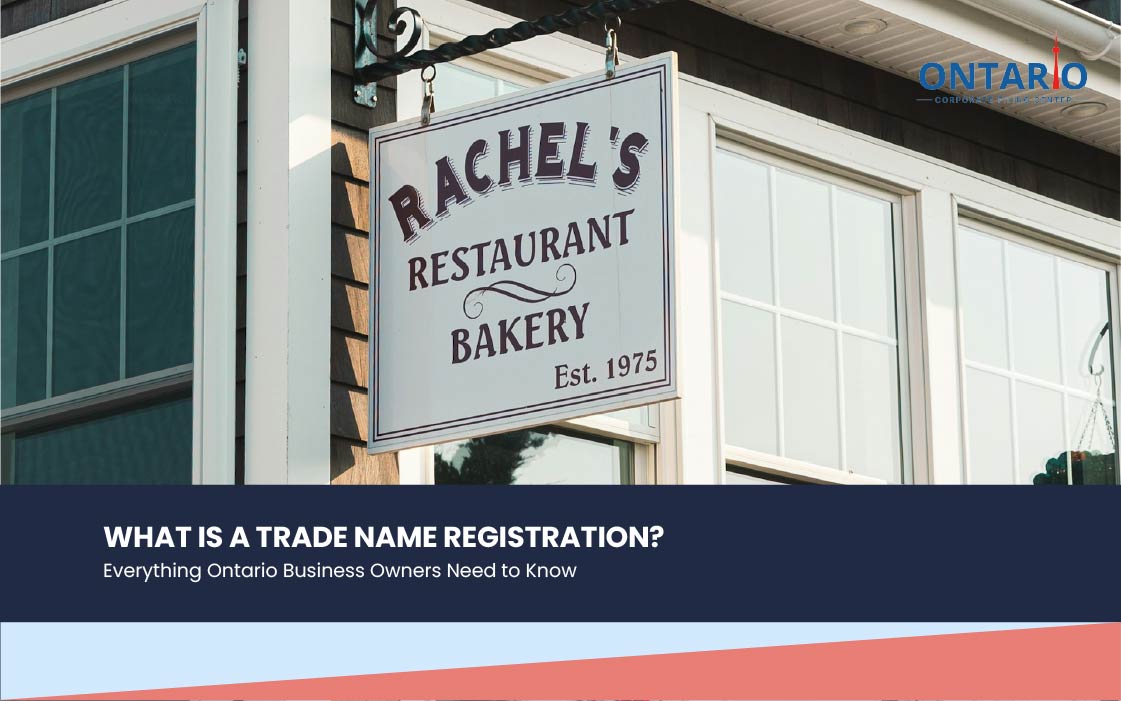
So, you’ve finally incorporated your business in Ontario. You’ve got your official corporate name, like “12345678 Ontario Inc.” or “Smith & Associates Global Ventures Ltd.” It sounds professional, but it doesn’t exactly scream “brand identity,” does it?
Maybe you want to launch a new line of artisanal coffee called “The Roasted Bean” or a landscaping division called “Green Thumb Pros.” You don’t want to change your entire corporate structure just for a new brand.
This is where a trade name in Ontario comes in. In the business world, this is often called an operating name or a “Doing Business As” (DBA) name. It allows you to keep your formal legal entity while presenting a catchy, market-friendly face to your customers.
In this guide, we’ll walk you through how to register a trade name in Ontario, the costs involved, and why choosing Corporation Ontario is the smartest way to handle your business filings.
What is a Trade Name Registration?
If you’re asking what is a trade name registration, think of it as a “nickname” for your corporation. Under the Business Names Act, an Ontario corporation is required to register any name it uses to conduct business that is different from its legal corporate name.
For example, if your legal name is “Northern Logistics Group Inc.” but your trucks say “FastTrack Delivery,” you must register “FastTrack Delivery” as a trade name.
Why Register?
- Legal Compliance: It is a legal requirement in Ontario.
- Banking: Most banks will not allow you to deposit checks made out to a business name unless you can show a valid registration for that name.
- Contracts: To sign leases or service agreements under your brand name, you need the legal proof that it’s linked to your corporation.
How to Register a Trade Name in Ontario
The process has moved almost entirely online through the Ontario Business Registry (OBR), but it still requires a few specific steps to get right. If you’re wondering how to register a trade name in Ontario, here is the 2026 roadmap:
Step 1: The Name Search
Before you register, you should ensure your desired name isn’t already being used by another business in a way that could cause confusion. While a trade name doesn’t provide the “exclusive protection” that a trademark does, the Ministry can still reject or cancel names that are too similar to existing ones.
Step 2: Gather Your Corporate Info
You will need your Ontario Corporation Number (OCN) and your Company Key. These are the security credentials that prove you have the authority to add a trade name to your existing corporation.
Step 3: Complete the Registration
You’ll provide your principal place of business, a brief description of what you do (using a NAICS code), and pay the provincial filing fee.
Pro Tip: Don’t want to deal with government logins and Company Keys? Corporation Ontario can handle the entire registration for you in minutes, ensuring every field is filled out correctly.
Operating Name vs. Corporation Name: The Big Difference
It’s easy to get these confused. Here is the breakdown:
- Legal Corporate Name: This is the name on your Articles of Incorporation (e.g., ABC Holdings Inc.). It must include a legal ending like “Inc.”, “Ltd.”, or “Corp.”
Trade Name / Operating Name: This is the brand name you use for signs, business cards, and marketing (e.g., ABC Cupcakes). It cannot include a legal ending like “Inc.” or “Ltd.” because the trade name itself is not a separate legal entity.
Comparison Table: Operating Name vs. Corporation Name
| Feature | Corporation Name (Legal Name) | Operating Name (Trade Name / DBA) |
|---|---|---|
| What it is | The official name on your Articles of Incorporation. | The "public-facing" brand name used for marketing. |
| Legal Status | A separate legal entity from the owner. | Not a separate legal entity; it is just a label. |
| Legal Suffix | Must end in Inc., Ltd., Corp., etc. | Cannot use a legal suffix (e.g., no "Inc."). |
| Used For | Government filings, taxes, and legal contracts. | Storefronts, logos, websites, and advertising. |
| Liability | Provides limited liability protection to owners. | No protection; liability falls on the corporation. |
| Quantity | One legal name per corporation. | One corporation can have multiple operating names. |
| Name Protection | High (provincial or federal protection). | Low (virtually no protection without a trademark). |
| Expiration | Valid as long as the corp exists. | Usually expires every 5 years (varies by province). |
| Banking | Required to open the main account. | Used to add a "Trading As" name to the account. |
Benefits of Registering a Trade Name
Why bother with an operating name? There are several strategic advantages of trade name registration:
- Multiple Brands, One Entity: A single corporation can register multiple trade names. You could have one corporation that operates a bakery, a catering company, and a cooking school—all under different names.
- Marketing Flexibility: You can drop the clunky “Inc.” or “Limited” from your marketing materials, making your brand feel more approachable.
- Cost-Effective Expansion: Registering a trade name is significantly cheaper than incorporating a whole new company every time you want to launch a new product line.
- Professionalism: It allows numbered companies (like 123456 Ontario Inc.) to trade under a real name that builds trust with local customers.
Myth vs. Fact: Trade Name Edition
- Myth: “Registering a trade name gives me ownership of that name across Canada.”
- Fact: False. A trade name registration only lets the government know you are the person behind that name in Ontario. It provides very little “name protection.” For exclusive rights, you need a Trademark.
- Myth: “My trade name can end in ‘Inc.’ if my corporation does.”
- Fact: False. This is a common legal mistake. Only the legal corporate entity can use “Inc.” Adding it to a trade name is misleading and can result in fines.
- Myth: “I only need to register once and I’m done forever.”
- Fact: False. In Ontario, a trade name registration (formerly called a Master Business Licence) expires every five years. You must renew it to keep it active.
Common Mistakes to Avoid
Failing to Renew: If your registration expires, you might lose your business bank account access. Mark your calendar for the 5-year anniversary!
Using a Prohibited Word: You cannot use words that imply a different legal structure (like “Association” or “Trust”) or words that suggest government affiliation.
Missing the 60-Day Window: If you start using a name and wait months to register it, you are technically in violation of the Business Names Act.
Frequently Asked Questions (FAQs)
Can I have more than one trade name?
Yes! Your corporation can have as many as you need. Each one requires its own registration and fee.
Does a trade name have its own tax ID?
No. Because the trade name is just a “label” for your corporation, it uses the same Business Number (BN) and HST number as your main company.
Can I change my trade name later?
You can’t “edit” the name itself. You would need to cancel the old registration and register a trade name in Ontario under the new name.
Why Choose Corporation Ontario?
Registering a business should be an exciting milestone, not a weekend spent wrestling with government portals and NAICS codes.
At Corporation Ontario, we make it simple. Our team of experts understands the nuances of the Ontario Business Registry. We don’t just “file” your paperwork; we review it to ensure your name meets provincial standards and your registration is processed as fast as possible.
Whether you’re launching a new “Doing Business As” name for your numbered company or rebranding an existing firm, we’ve got you covered.
Ready to give your business the name it deserves? Register your Ontario Trade Name with Corporation Ontario today!