
- What Is a Sole Proprietorship?
- Advantages of a Sole Proprietorship
- Disadvantages of a Sole Proprietorship
- How Sole Proprietorship Taxes Work in Ontario
- Sole Proprietorship vs Corporation: Which Is Right for You
- When Should You Switch from a Sole Proprietorship to a Corporation?
- Do You Need to Register Your Sole Proprietorship?
- Frequently Asked Questions
What Is an Ontario Sole Proprietorship?
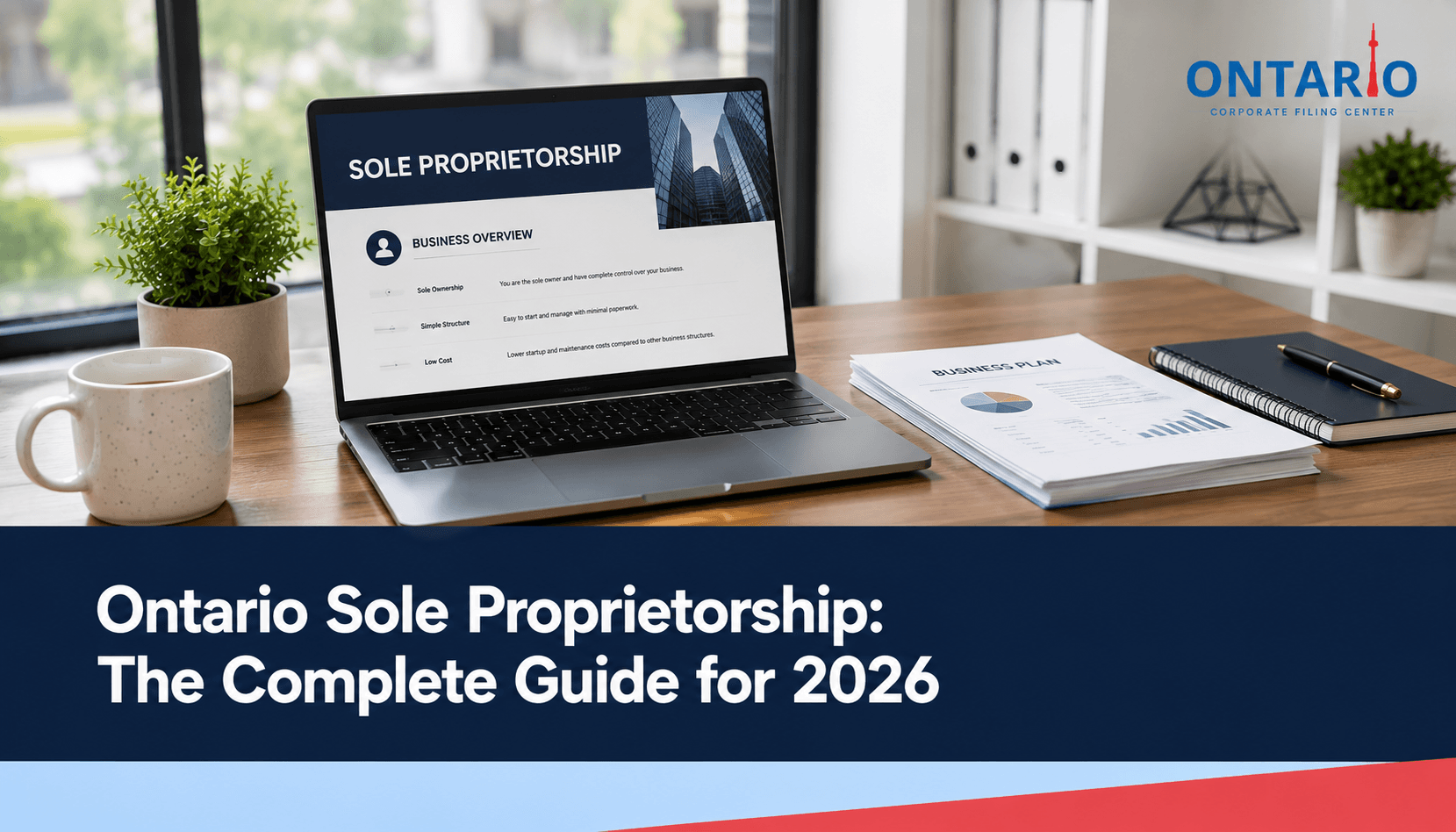
An Ontario sole proprietorship is the simplest business structure available, owned and run by one person with no legal separation between the owner and the business. It’s fast and inexpensive to set up, but it comes with unlimited personal liability, meaning your personal assets aren’t protected if the business runs into debt or legal trouble.
Choosing how to structure your business is one of the first real decisions you’ll make as an entrepreneur, and it shapes your taxes, your liability, and the amount of paperwork you’ll deal with for years to come. This guide walks through exactly what a sole proprietorship is, its real advantages and disadvantages, and how to know whether it’s the right fit for you or whether incorporating makes more sense.
What Is a Sole Proprietorship?
A sole proprietorship is the most basic form of business ownership. One person owns and operates the business, and there is no legal distinction between the individual and the business itself. Any income the business earns is your personal income. Any debt the business takes on is your personal debt.
This is different from a corporation, which creates a separate legal entity. A corporation can own property, enter into contracts, and be sued in its own name. A sole proprietorship can’t. Legally, it’s just you doing business.
Advantages of a Sole Proprietorship
Low Cost and Simple Setup
There’s no incorporation fee, no Articles of Incorporation, and far less paperwork to get started. If you’re operating under your own legal name, you may not even need to register.
Full Control
You make every decision without needing to consult shareholders, a board, or a co-owner. The business operates exactly as you want it to.
Simple Tax Filing
Business income and losses are reported directly on your personal income tax return. There’s no separate corporate tax return to file, which keeps accounting costs lower, especially in the early stages.
Easy to Wind Down
If the business doesn’t work out, closing a sole proprietorship is far simpler than dissolving a corporation.
Disadvantages of a Sole Proprietorship
Unlimited Personal Liability
This is the big one. If your business is sued or can’t pay its debts, creditors can go after your personal assets, your home, your car, and your savings, not just what you’ve invested in the business. A corporation’s limited liability protection doesn’t exist here.
Harder to Raise Funding
Banks and investors are often more cautious about lending to or investing in a sole proprietorship, since there’s no separate legal entity and no shares to offer in exchange for investment.
Less Credibility With Some Clients
Larger clients, government contracts, and some industries expect to see “Inc.” or “Ltd.” after a business name. A sole proprietorship can sometimes come across as less established, fairly or unfairly.
No Tax Deferral Advantage
Corporations can leave profit inside the company and pay a lower corporate tax rate on it. As a sole proprietor, all your business income is taxed at your personal rate in the year you earn it, with no ability to defer.
How Sole Proprietorship Taxes Work in Ontario
As a sole proprietor, you report your business income and expenses on your personal income tax return, generally using a T2125 form alongside your regular T1 return. There’s no separate corporate tax rate to take advantage of; your business profit is simply added to your other personal income and taxed at your marginal personal rate.
This is simpler to manage, especially if you’re just starting and don’t have an accountant yet, but it also means there’s no opportunity to smooth out your tax bill by leaving money inside a lower-taxed corporation the way an incorporated business owner can. This is general information only; your specific tax situation should be reviewed with an accountant.
Sole Proprietorship vs Corporation: Which Is Right for You
| Sole Proprietorship | Corporation | |
|---|---|---|
| Personal liability | Unlimited, personal assets at risk | Limited, generally protected |
| Setup cost | Low, often no registration fee if using your own name | Government filing fee plus optional add-ons |
| Tax treatment | Personal income tax rate, no deferral | Lower corporate rate, income can be deferred |
| Credibility | Can appear less established | Often seen as more professional |
| Complexity | Minimal ongoing paperwork | Annual returns, corporate records, more filing |
| Best for | Testing an idea, low-risk services, solo freelancers | Growing businesses, higher liability exposure, plans to raise funding |
If you’re testing a business idea, working with low financial risk, or freelancing without major liability exposure, a sole proprietorship is often the practical starting point. If you’re taking on debt, hiring employees, working in a higher-liability industry, or planning to bring in investors, incorporating a business in Ontario is usually worth the extra setup and cost.
When Should You Switch from a Sole Proprietorship to a Corporation?
There’s no single rule that fits every business, but a few signs generally point toward incorporating:
Your Income Is Growing
Your business income is growing to a point where the corporate tax rate would meaningfully reduce your tax bill compared to your personal rate.
You’re Taking on Real Liability Risk
You’re signing larger contracts, hiring staff, or working in an industry where lawsuits are more common.
You Want to Bring on Investors or Partners
This requires the share structure a corporation provides.
You Want the Credibility of “Inc.” or “Ltd.”
When working with larger clients or government contracts, operating as a corporation often carries more weight.
If none of these apply yet, staying a sole proprietorship and revisiting the decision as your business grows is a completely reasonable approach.
Do You Need to Register Your Sole Proprietorship?
If you’re operating strictly under your own legal name, for example, “Sarah Chen,” offering consulting services as just “Sarah Chen,” you generally don’t need to register anything. The moment you operate under any other name, like “Chen Consulting,” Ontario’s Business Names Act requires you to register that name.
The registration process itself is straightforward and covered step by step in our complete guide to registering a sole proprietorship in Ontario, including exactly what information you’ll need and how long the process takes.
Frequently Asked Questions
Is a sole proprietorship the same as being self-employed?
Largely, yes. Most self-employed individuals operating without incorporating are, by default, sole proprietors.
Can a sole proprietorship have employees?
Yes. You can hire employees as a sole proprietor, though you take on personal liability for payroll obligations and workplace matters since there’s no separate corporate entity to absorb that risk.
Is my personal home at risk with a sole proprietorship?
Potentially, yes. Since there’s no legal separation between you and the business, personal assets, including your home, can be at risk if the business is sued or can’t pay its debts.
Do I need a business number as a sole proprietor?
You’ll typically need one if you register a business name, hire employees, or need to collect GST/HST once you exceed the small supplier threshold.
Can I convert a sole proprietorship into a corporation later?
Yes, this is common. Many businesses start as a sole proprietorship to keep costs low, then incorporate once they’ve validated the business and outgrown the structure’s limitations.
Do sole proprietors pay less tax than corporations?
Not necessarily. Sole proprietors pay personal income tax rates with no deferral option, while corporations pay a lower rate but only on income kept inside the company. Which one is actually lower depends on your income level and how the profit is used.
Ready to Decide?
Whether a sole proprietorship or a corporation is the right fit depends on your risk tolerance, your growth plans, and how much liability protection matters to you right now. At Ontario Corporate Filing Center, we help entrepreneurs set up either structure correctly from the start.
If a sole proprietorship fits where you are today, you can register your Ontario sole proprietorship with us directly or read our complete guide to registering a sole proprietorship in Ontario for the full step-by-step process. If you’re ready for the liability protection and tax structure a corporation offers, you can incorporate a business in Ontario with us in as little as a few hours.
Register Your Sole Proprietorship